C1.3.2 LIGHT-INDEPENDENT REACTIONS CALVIN CYCLE
📌Definition Table
| Term | Definition |
|---|---|
| Calvin cycle | Light-independent pathway in the chloroplast stroma that fixes CO₂ into carbohydrates using ATP and NADPH. |
| Carbon fixation | Incorporation of atmospheric CO₂ into organic molecules. |
| Rubisco | Enzyme that catalyzes the first step of carbon fixation by attaching CO₂ to RuBP. |
| RuBP (ribulose-1,5-bisphosphate) | Five-carbon compound that reacts with CO₂ in the Calvin cycle. |
| GP (3-phosphoglycerate) | First stable product of CO₂ fixation. |
| TP (triose phosphate) | Three-carbon sugar produced in the Calvin cycle, used for carbohydrate synthesis. |
| Regeneration | Process of reforming RuBP from TP so the cycle can continue. |
📌Introduction
The Calvin cycle, also called the light-independent reactions, occurs in the stroma of chloroplasts. It uses the ATP and NADPH generated in the light-dependent stage to fix CO₂ and synthesize carbohydrate precursors. This cycle does not directly require light but is indirectly dependent on it, since its energy and reducing power come from the light reactions.
📌 Stages of the Calvin Cycle
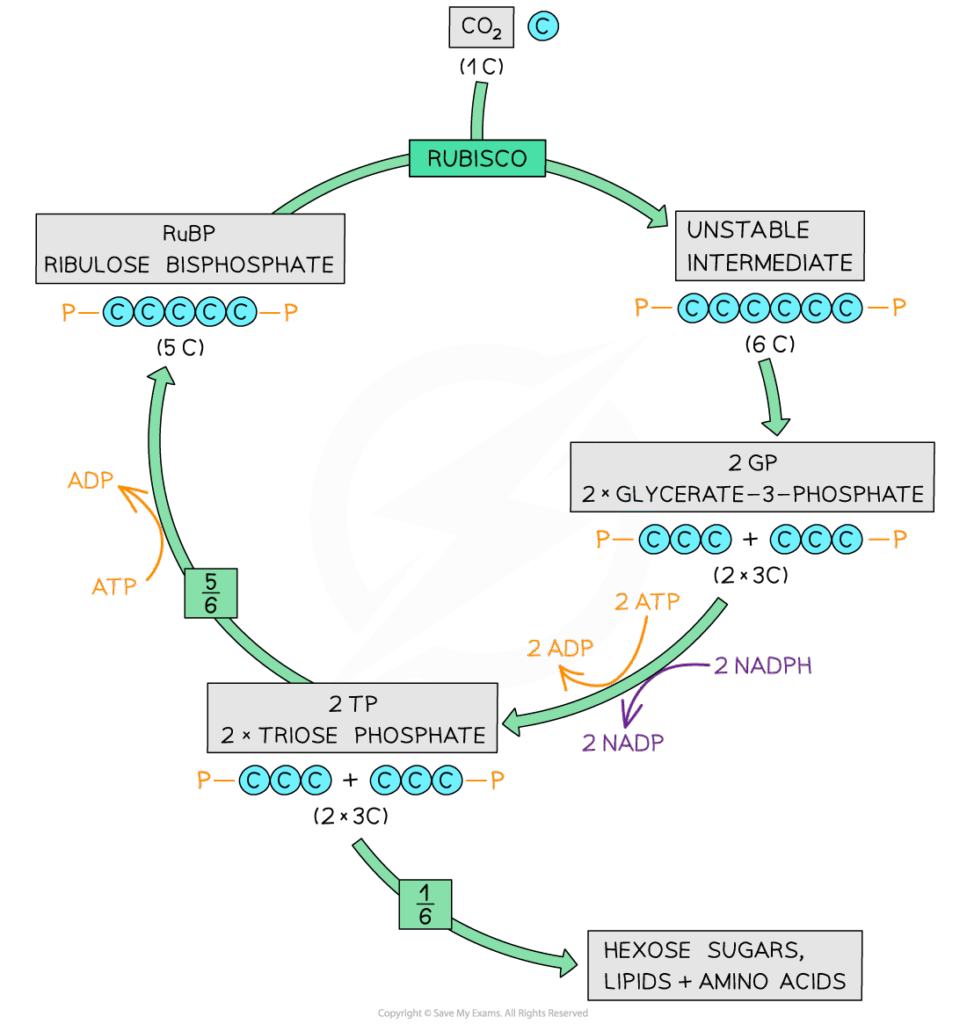
- Carbon Fixation
- CO₂ combines with RuBP (5C) to form an unstable 6C compound.
- Reaction catalyzed by Rubisco, the most abundant enzyme on Earth.
- The 6C intermediate immediately breaks down into two molecules of GP (3C).
- Reduction
- GP is reduced to TP (triose phosphate) using:
- ATP (energy source).
- NADPH (reducing agent).
- TP is the key output: it can form glucose, amino acids, fatty acids.
- GP is reduced to TP (triose phosphate) using:
- Regeneration of RuBP
- Most TP molecules are recycled to regenerate RuBP using ATP.
- Ensures the cycle continues.
- Products per 3 turns (fixing 3 CO₂):
- 6 TP formed, but only 1 TP exits to contribute to glucose synthesis.
- 5 TP recycled to regenerate 3 RuBP.
- Net result per glucose (6 CO₂ fixed):
- 2 TP used → 1 glucose.
- Requires 18 ATP and 12 NADPH.
🧠 Examiner Tip: Many students wrongly state that Calvin cycle produces glucose directly. Always emphasize that TP is the actual product; glucose forms after multiple turns.
📌 Regulation and Dependency
- Calvin cycle depends on ATP and NADPH from light-dependent reactions.
- If light is absent, ATP and NADPH are unavailable → cycle halts.
- Rubisco is sensitive to CO₂ and O₂ levels; high O₂ can trigger photorespiration, reducing efficiency.
🧬 IA Tips & Guidance: Students can measure the effect of light intensity or CO₂ concentration on photosynthetic rate using leaf disk assays, directly linking data to Calvin cycle activity.
📌 Outputs of the Calvin Cycle
- TP → forms glucose, sucrose, starch, cellulose (carbohydrates).
- TP also provides precursors for lipids and amino acids.
- ATP and NADPH are converted back into ADP, Pi, and NADP⁺, which return to the light reactions.
🌐 EE Focus: An EE could analyze Rubisco activity under varying environmental conditions, or model Calvin cycle efficiency under elevated CO₂ (climate change relevance).
📌 Role of Chloroplast Structure in Calvin Cycle
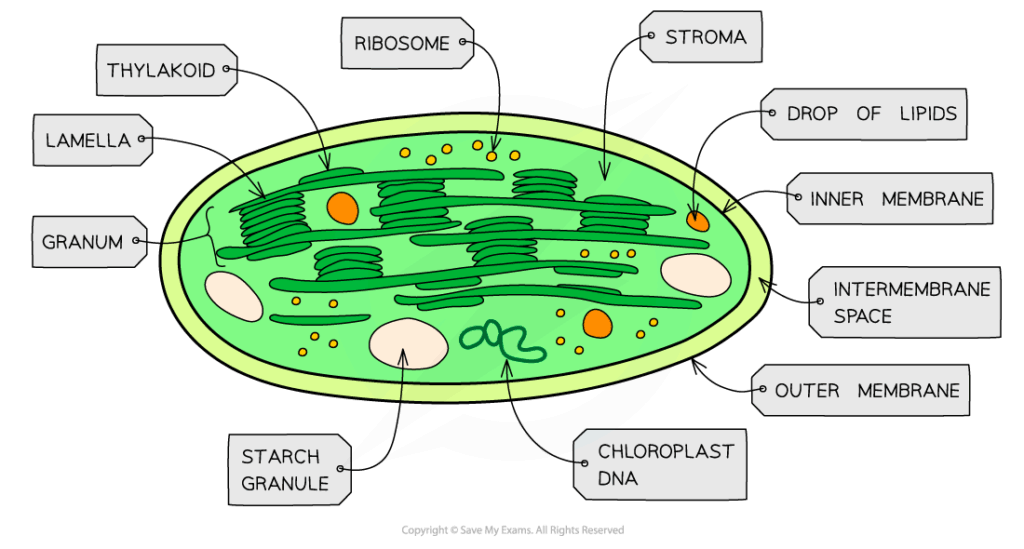
- Stroma contains enzymes of Calvin cycle.
- Close proximity to thylakoids ensures rapid supply of ATP/NADPH.
- Double membrane maintains suitable internal environment.
❤️ CAS Link: Students could design community projects on sustainable farming, showing how plant photosynthesis underpins global food security.
🌍 Real-World Connection: Calvin cycle efficiency determines global food production and carbon cycling. Rising atmospheric CO₂ and climate change directly impact Rubisco activity and crop yields. Biotechnology efforts aim to engineer more efficient Rubisco to boost photosynthesis.
📌 Integration of Calvin Cycle
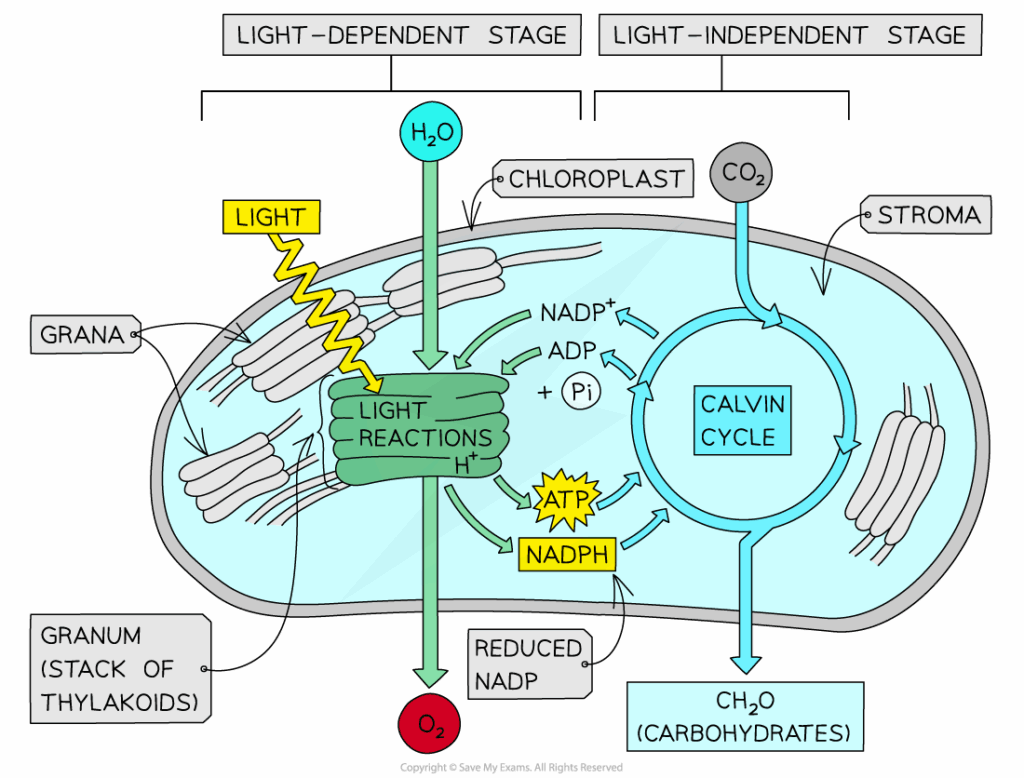
- Links with light-dependent stage via ATP and NADPH supply.
- Provides organic molecules feeding into cellular respiration, biosynthesis, and growth.
🔍 TOK Perspective: Rubisco’s inefficiency raises a TOK question: How do scientific explanations account for imperfections in natural systems, and does “efficiency” reflect human bias in evaluating biology?