C1.2.3 AEROBIC VS ANAEROBIC RESPIRATION
📌Definition Table
| Term | Definition |
|---|---|
| Aerobic respiration | Complete oxidation of glucose in the presence of oxygen, producing CO₂, H₂O, and large amounts of ATP. |
| Anaerobic respiration (fermentation) | Incomplete breakdown of glucose without oxygen, producing less ATP and byproducts such as lactate or ethanol. |
| Facultative anaerobe | Organism that can switch between aerobic and anaerobic respiration depending on oxygen availability (e.g., yeast). |
| Obligate anaerobe | Organism that cannot survive in the presence of oxygen. |
| Oxygen debt | Temporary lack of oxygen in tissues during strenuous exercise, repaid during recovery when lactate is metabolized. |
| Lactic acid fermentation | Anaerobic pathway in animals where pyruvate is converted into lactate. |
| Alcoholic fermentation | Anaerobic pathway in yeast where pyruvate is converted into ethanol and CO₂. |
📌Introduction
Respiration is the central energy-yielding process in cells. The presence or absence of oxygen determines whether cells use aerobic respiration, which yields high amounts of ATP, or anaerobic respiration, which provides rapid but inefficient ATP production. Both pathways begin with glycolysis, but diverge in how pyruvate is processed. This flexibility allows organisms to adapt to changing environmental conditions and energy demands.
📌 Aerobic Respiration
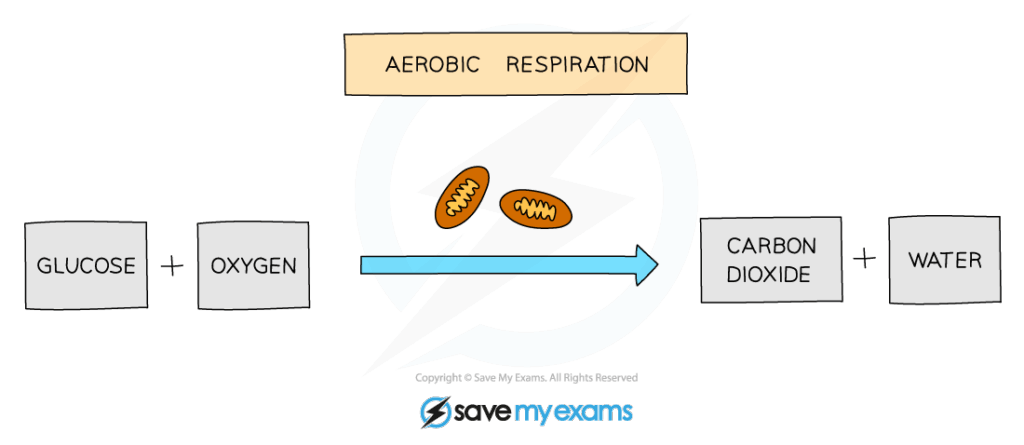
- Requires oxygen as the final electron acceptor in the electron transport chain.
- Pyruvate enters the mitochondria → link reaction → Krebs cycle → oxidative phosphorylation.
- Complete oxidation of glucose yields up to ~36–38 ATP per glucose.
- Produces CO₂ and H₂O as waste products.
- Highly efficient, sustaining long-term energy supply in eukaryotic organisms.
🧠 Examiner Tip: Always emphasize that oxygen is needed only for oxidative phosphorylation as the final electron acceptor, not for glycolysis or the Krebs cycle itself.
📌 Anaerobic Respiration
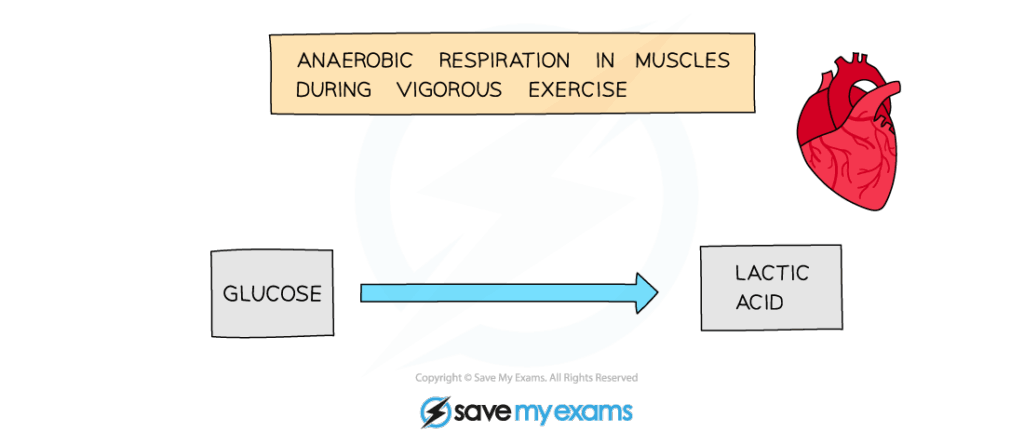
- Occurs when oxygen is absent or limited.
- Pyruvate is reduced to regenerate NAD⁺, allowing glycolysis to continue.
- In animals: pyruvate → lactate (lactic acid fermentation).
- Lactate accumulation causes muscle fatigue; later transported to the liver and converted back to pyruvate (Cori cycle).
- In yeast/plants: pyruvate → ethanol + CO₂ (alcoholic fermentation).
- Used in brewing, baking, and biofuel production.
- Net yield = 2 ATP per glucose, much lower than aerobic respiration.
🧬 IA Tips & Guidance: Yeast fermentation is a popular IA topic. Students can measure CO₂ output under different sugar types or oxygen availability, linking data to aerobic vs anaerobic pathways.
📌 Comparison of Aerobic vs Anaerobic Respiration
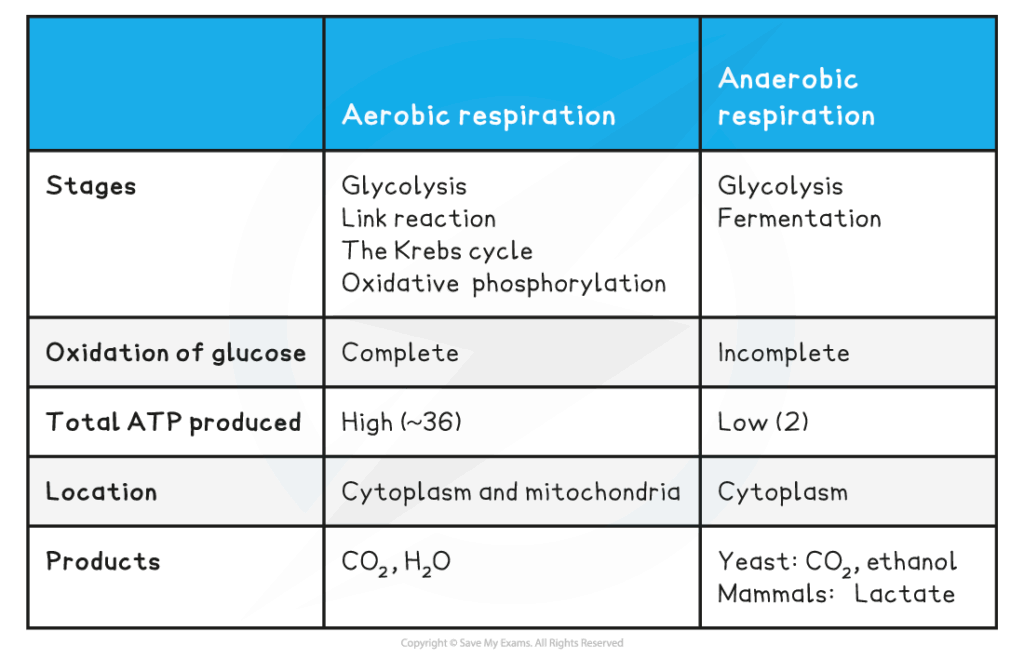
- ATP yield: Aerobic = 36–38 ATP; Anaerobic = 2 ATP.
- Speed: Anaerobic is faster but inefficient; aerobic is slower but sustainable.
- End products: Aerobic → CO₂ + H₂O; Anaerobic → lactate or ethanol + CO₂.
- Location: Aerobic = mitochondria; Anaerobic = cytoplasm.
- Use in organisms: Anaerobic respiration provides short-term energy bursts (e.g., sprinting), aerobic respiration supports long-duration activities.
🌐 EE Focus: An EE could compare ATP yields in aerobic vs anaerobic organisms, or experimentally analyze fermentation efficiency in yeast under varied oxygen conditions. Another approach is modeling how oxygen availability affects metabolic flux.
📌 Physiological Significance
- During vigorous exercise, muscles switch to anaerobic respiration to meet energy demand.
- Oxygen debt is repaid afterward when lactate is oxidized in the liver.
- Facultative anaerobes like yeast exploit both pathways depending on environmental oxygen.
- Obligate anaerobes thrive in oxygen-free niches such as deep soils and sediments.
❤️ CAS Link: Students could organize sports-based workshops explaining the science behind aerobic and anaerobic respiration in muscle activity, linking biology to exercise and fitness.
🌍 Real-World Connection: Fermentation has industrial applications in brewing, baking, yogurt production, and biofuels. Anaerobic respiration in microbes underpins waste treatment and biogas generation. Clinically, understanding lactic acidosis is crucial in emergency medicine, while aerobic deficiencies (mitochondrial diseases) impair energy metabolism.
📌 Adaptations to Oxygen Availability
- Some organisms have metabolic flexibility (yeast, bacteria).
- Human muscle fibers specialize:
- Fast-twitch fibers rely on anaerobic glycolysis.
- Slow-twitch fibers depend on aerobic respiration with abundant mitochondria.
- Evolutionary adaptations show how life colonizes both oxygen-rich and oxygen-poor environments.
🔍 TOK Perspective: ATP yield numbers (36–38 ATP) are based on idealized calculations. TOK reflection: How should science handle uncertainty in data, and how do models balance accuracy with simplicity in teaching complex processes?