C1.2.2 KREBS CYCLE AND OXIDATIVE PHOSPHORYLATION
📌Definition Table
| Term | Definition |
|---|---|
| Krebs cycle (citric acid cycle) | A cyclic series of enzyme-catalyzed reactions in the mitochondrial matrix that oxidize acetyl-CoA, releasing CO₂, ATP, NADH, and FADH₂. |
| Oxidative phosphorylation | ATP synthesis driven by electron transport and chemiosmosis in mitochondria. |
| Electron transport chain (ETC) | Series of protein complexes in the inner mitochondrial membrane that transfer electrons, releasing energy to pump protons. |
| Chemiosmosis | Movement of protons down their electrochemical gradient through ATP synthase, driving ATP production. |
| NADH / FADH₂ | Reduced coenzymes that donate high-energy electrons to the ETC. |
| ATP synthase | Enzyme complex in the inner mitochondrial membrane that couples proton flow to ATP formation. |
| Cytochrome | Electron carrier proteins within the ETC that transfer electrons between complexes. |
📌Introduction
The Krebs cycle and oxidative phosphorylation are the final stages of aerobic respiration, occurring in the mitochondria. Together, they extract maximum energy from glucose by oxidizing acetyl-CoA to CO₂ and using the released electrons to generate a proton gradient for ATP synthesis. The Krebs cycle produces electron carriers, while oxidative phosphorylation harnesses their reducing power to make the majority of ATP in respiration.
📌 The Krebs Cycle
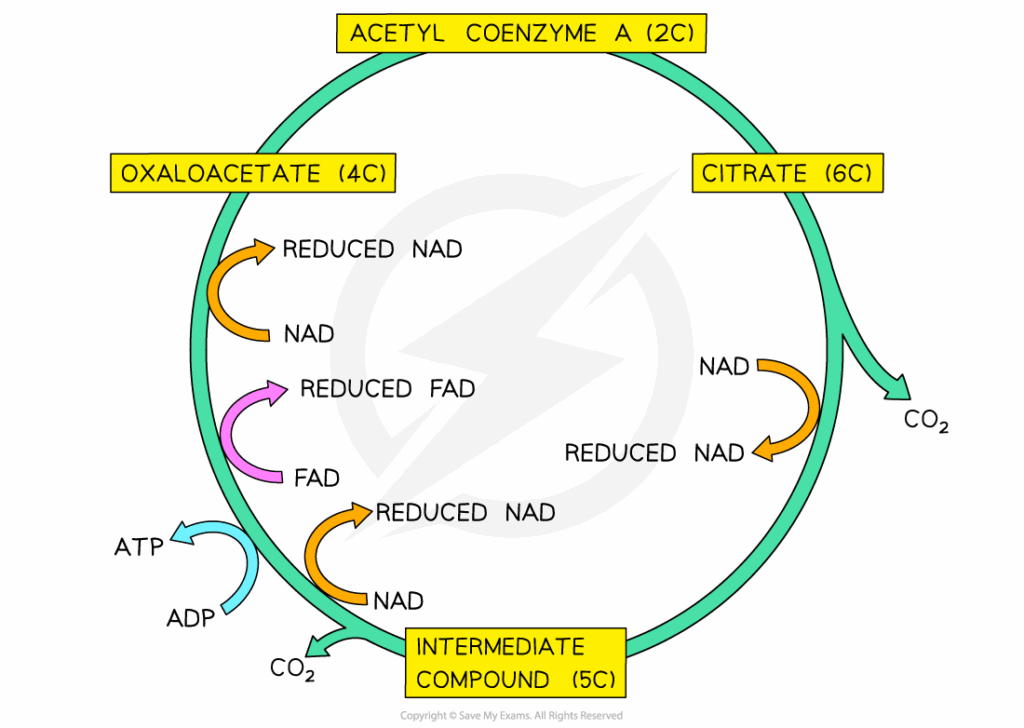
- Takes place in the mitochondrial matrix.
- Acetyl-CoA (2C) combines with oxaloacetate (4C) to form citrate (6C).
- Through a series of decarboxylations and oxidations, citrate is converted back into oxaloacetate.
- Per acetyl-CoA (per turn):
- 3 NADH, 1 FADH₂, 1 ATP (substrate-level), and 2 CO₂ are produced.
- Per glucose (2 acetyl-CoA):
- 6 NADH, 2 FADH₂, 2 ATP, 4 CO₂.
- The cycle is regenerative, ensuring continuous processing of acetyl-CoA.
🧠 Examiner Tip: Always state that CO₂ is a waste product of respiration, not a source of oxygen in photosynthesis — a common student error.
📌 Oxidative Phosphorylation and the ETC
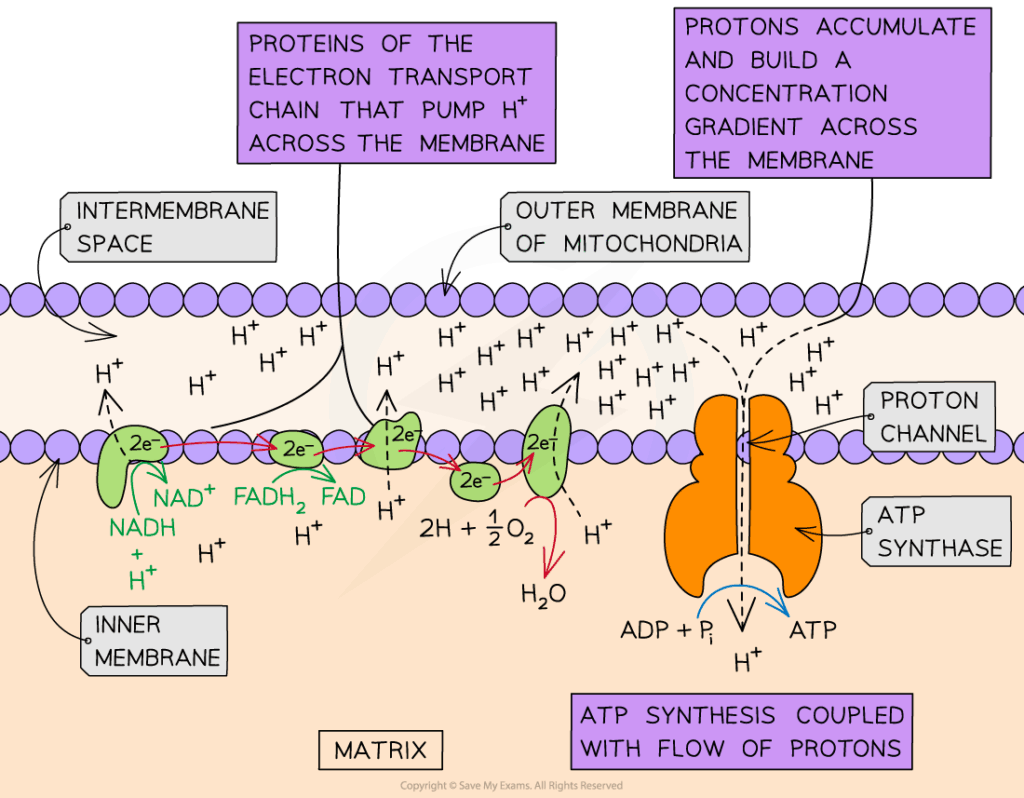
- Located in the inner mitochondrial membrane.
- NADH and FADH₂ donate electrons to the ETC.
- Electrons flow through protein complexes I–IV, releasing energy.
- This energy is used to pump protons into the intermembrane space, creating a steep gradient.
- Protons re-enter the matrix via ATP synthase, which couples the flow to ATP production.
- Oxygen acts as the final electron acceptor, combining with electrons and protons to form water.
- Each NADH yields ~3 ATP, each FADH₂ yields ~2 ATP.
- Total ATP from oxidative phosphorylation per glucose ≈ 34.
🧬 IA Tips & Guidance: A classic IA experiment is to measure oxygen consumption of respiring seeds or small invertebrates using a respirometer. Link results to ETC activity and oxidative phosphorylation.
📌 Regulation and Efficiency
- The ETC rate depends on oxygen availability — if oxygen is absent, oxidative phosphorylation stops.
- Uncouplers (e.g., DNP) allow protons to leak across the membrane, reducing ATP yield but producing heat.
- Efficiency of respiration ≈ 34–38% (rest lost as heat).
🌐 EE Focus: An EE could investigate the effect of inhibitors (cyanide, rotenone) on ETC enzymes or explore the role of mitochondrial adaptations in high-energy tissues like muscle and brain.
📌 Mitochondrial Adaptations for Oxidative Phosphorylation
- Highly folded inner membrane (cristae) → large surface area for ETC and ATP synthase.
- Double membrane creates intermembrane space for proton gradient.
- Matrix contains enzymes of Krebs cycle and mitochondrial DNA for protein synthesis.
- Dense distribution of mitochondria in tissues with high energy demand (e.g., cardiac muscle).
❤️ CAS Link: Students could run fitness or sports workshops explaining how aerobic respiration supports endurance exercise, connecting biology to healthy lifestyles.
🌍 Real-World Connection: Mitochondrial diseases often arise from defects in ETC proteins, leading to fatigue and organ failure. In medicine, inhibitors like cyanide highlight the importance of oxygen as the terminal electron acceptor. In industry, oxidative phosphorylation principles are applied in bioenergetics research and drug design for metabolic disorders.
📌 ATP Yield Summary (per glucose)
- Glycolysis: 2 ATP + 2 NADH.
- Link reaction: 2 NADH.
- Krebs cycle: 2 ATP + 6 NADH + 2 FADH₂.
- Oxidative phosphorylation: ~34 ATP.
- Total: ~38 ATP (in ideal conditions, varies by cell type).
🔍 TOK Perspective: ATP yield calculations assume idealized conditions. TOK reflection: To what extent can scientific models be treated as exact representations when biological systems are inherently variable?