C1.2.1 GLYCOLYSIS AND LINK REACTION
📌Definition Table
| Term | Definition |
|---|---|
| Glycolysis | Metabolic pathway in the cytoplasm that breaks down glucose (6C) into two pyruvate (3C) molecules, producing a small yield of ATP and NADH. |
| Substrate-level phosphorylation | Direct synthesis of ATP by transferring a phosphate group to ADP during glycolysis or Krebs cycle. |
| NAD⁺ / NADH | Coenzyme that acts as an electron carrier; NAD⁺ is reduced to NADH during glycolysis. |
| Pyruvate | Three-carbon product of glycolysis, central to both aerobic and anaerobic metabolism. |
| Link reaction | Step connecting glycolysis to the Krebs cycle, where pyruvate is decarboxylated and combined with coenzyme A to form acetyl-CoA. |
| Acetyl-CoA | Two-carbon molecule that enters the Krebs cycle, carrying acetyl groups derived from carbohydrates, fats, or proteins. |
📌Introduction
Cell respiration begins with glycolysis, a universal pathway occurring in the cytoplasm of all living cells. It requires no oxygen and produces a net gain of ATP and NADH. Pyruvate, the end product, is a key metabolic intermediate, entering aerobic or anaerobic pathways depending on oxygen availability. In aerobic organisms, pyruvate is transported into mitochondria for the link reaction, producing acetyl-CoA, which fuels the Krebs cycle. Together, glycolysis and the link reaction form the foundation of cellular energy metabolism.
📌 Steps of Glycolysis
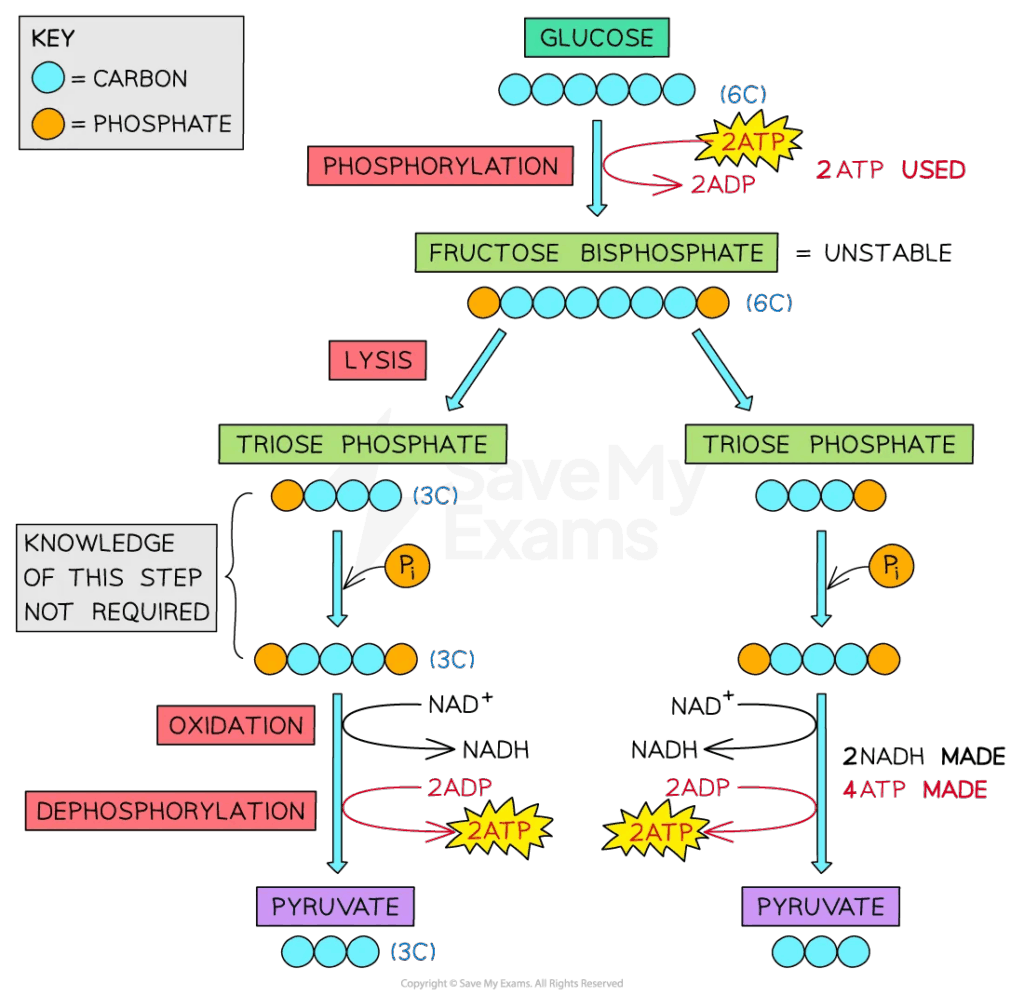
- Occurs in the cytoplasm and does not require oxygen.
- Energy investment phase:
- 2 ATP molecules are used to phosphorylate glucose into fructose-1,6-bisphosphate.
- Cleavage phase:
- The 6C sugar is split into two 3C molecules (glyceraldehyde-3-phosphate).
- Energy payoff phase:
- Each 3C molecule is oxidized, producing 2 NADH and 4 ATP (via substrate-level phosphorylation).
- Net yield per glucose:
- 2 pyruvate, 2 NADH, and 2 ATP.
🧠 Examiner Tip: Always specify net ATP gain = 2 (4 produced − 2 used). Many students mistakenly write 4 ATP as the yield of glycolysis.
📌 The Link Reaction
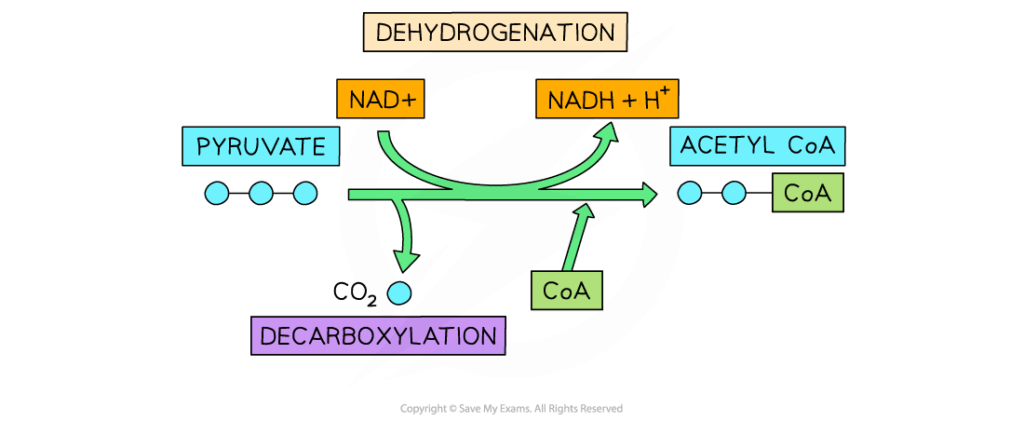
- Occurs in the mitochondrial matrix (in eukaryotes).
- Each pyruvate (3C) undergoes:
- Decarboxylation: CO₂ is released.
- Oxidation: NAD⁺ is reduced to NADH.
- The resulting 2C acetyl group is attached to coenzyme A, forming acetyl-CoA.
- For each glucose:
- 2 pyruvate → 2 acetyl-CoA + 2 NADH + 2 CO₂.
- Acetyl-CoA enters the Krebs cycle, linking cytoplasmic glycolysis to mitochondrial aerobic respiration.
🧬 IA Tips & Guidance: Students can investigate respiration rate in yeast by measuring CO₂ production with respirometers under different sugar substrates (glucose vs fructose). Link experimental design to glycolysis dependence on substrate type.
📌 Regulation of Glycolysis
- Phosphofructokinase (PFK) is a key regulatory enzyme inhibited by ATP (feedback inhibition).
- When ATP is low, PFK is activated, increasing glycolysis.
- This ensures balance between energy demand and glucose breakdown.
🌐 EE Focus: An EE could investigate comparative rates of glycolysis in plant vs yeast cells under controlled conditions, or computational modeling of PFK regulation and its effect on ATP yield.
📌 Metabolic Importance of Glycolysis and Link Reaction
- Provides ATP rapidly, essential in cells with high, fluctuating energy demands (e.g., muscle cells).
- Produces pyruvate as a metabolic hub — can enter aerobic respiration, anaerobic fermentation, or biosynthetic pathways.
- NADH generated provides reducing power for oxidative phosphorylation.
- The link reaction ensures carbohydrate breakdown is efficiently integrated into mitochondrial metabolism.
❤️ CAS Link: Students could create interactive models or demonstrations showing how glucose in foods (bread, fruits) is broken down into ATP, linking biology to everyday nutrition and health awareness.
🌍 Real-World Connection: Glycolysis is exploited in cancer diagnosis because tumor cells show increased glycolytic activity even in oxygen presence (Warburg effect). Clinically, glycolytic enzymes are used as biomarkers for metabolic disorders. In biotechnology, fermentation industries (bread, beer, bioethanol) rely on glycolysis in yeast to produce CO₂ and ethanol.
📌 Pyruvate Fate and Pathway Integration
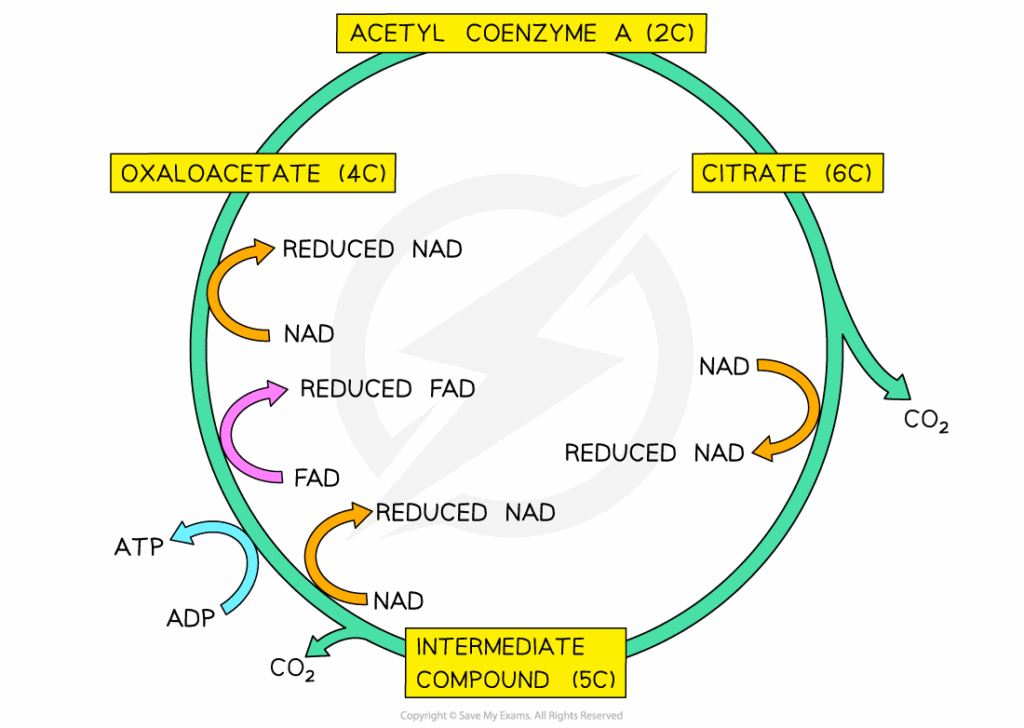
- Under aerobic conditions → enters mitochondria for link reaction → Krebs cycle.
- Under anaerobic conditions → converted into lactate (in animals) or ethanol + CO₂ (in yeast).
- This dual role highlights glycolysis as a universal and adaptable pathway.
🔍 TOK Perspective: Glycolysis was elucidated using indirect biochemical experiments long before modern imaging. TOK reflection: How do scientists build reliable models of processes they cannot directly observe, and to what extent can indirect evidence be trusted?